Most “chat with your data” tools give you a number. Eternity gives you a number you can defend — to your boss, your client, or an auditor. Everything below is about the part that comes after the answer: can you see how it was computed, where it came from, whether to trust it, and whether it'll still be true tomorrow.
Here's what's actually in the product today.
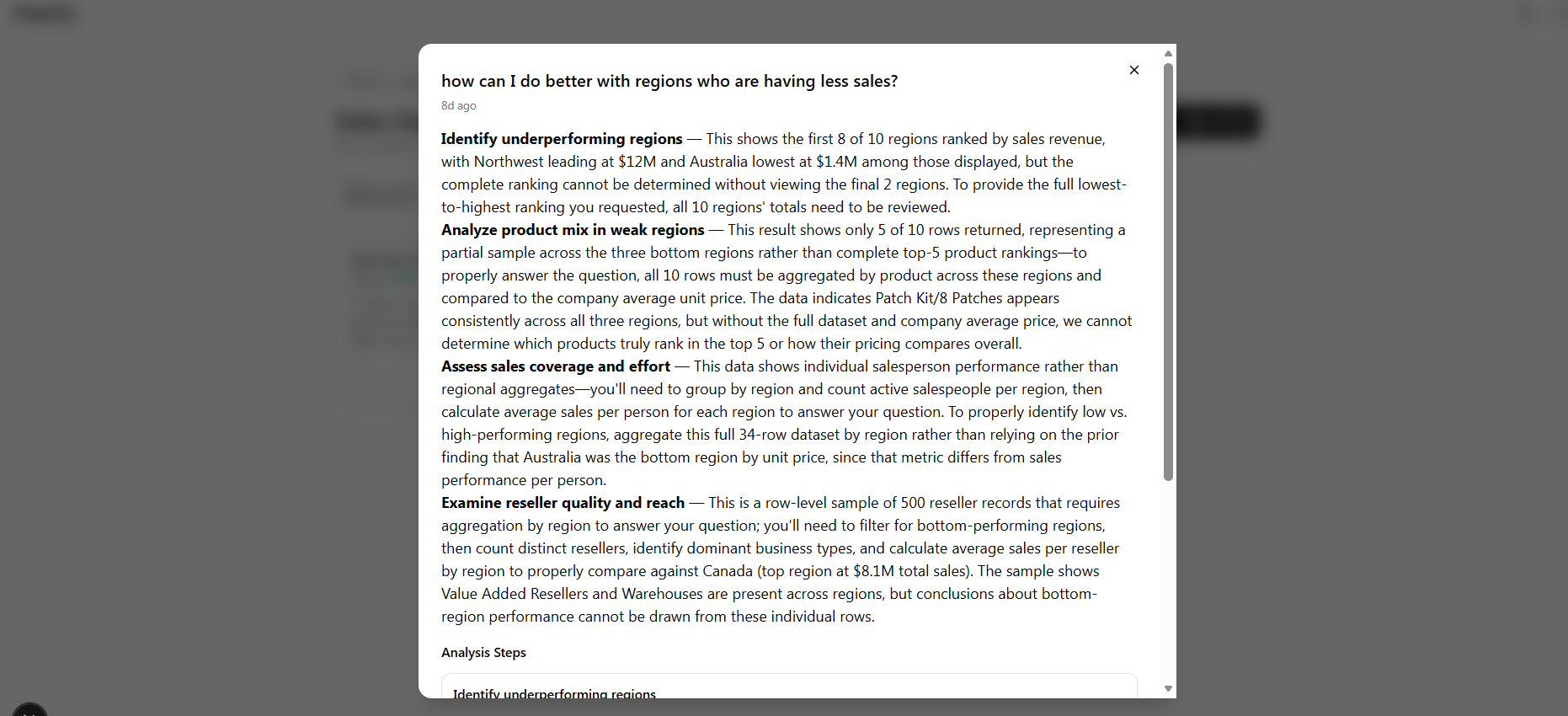
1. Every answer ships its SQL
There is no black box. Every structured answer comes with a View SQL button showing the exact query that produced the number — copyable, runnable, reviewable. If you don't trust the answer, read the query. If your reviewer doesn't trust it, hand them the query.
This is the single biggest difference from a code-interpreter that writes throwaway Python you never see.
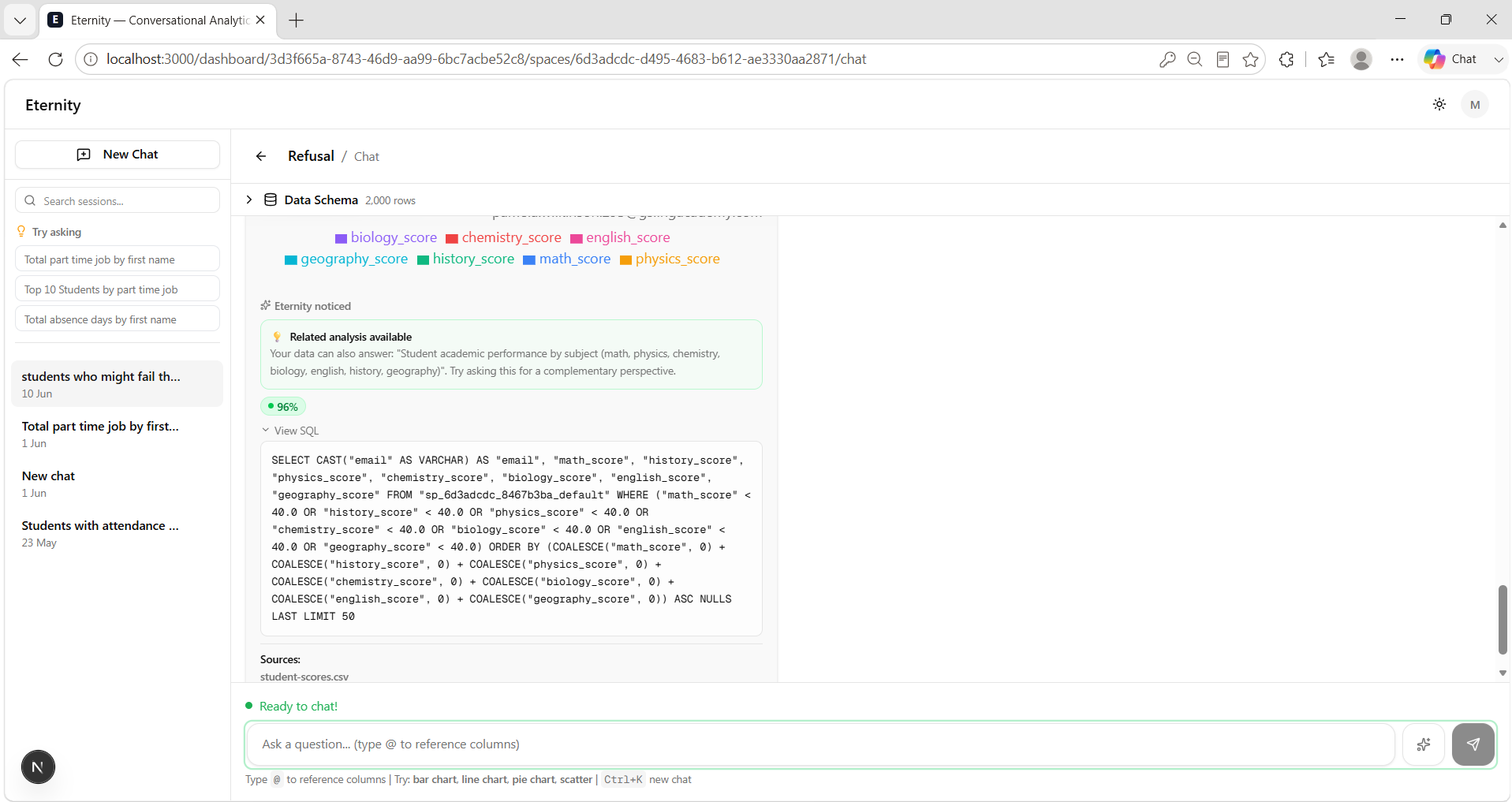
2. Click a number, see the source rows
Row-level lineage: every aggregate traces back to the exact rows that fed it. Click a total and Eternity shows you the individual transactions behind it — across joined files. “Where did this ₹6 crore come from?” is one click, not a forensic exercise.
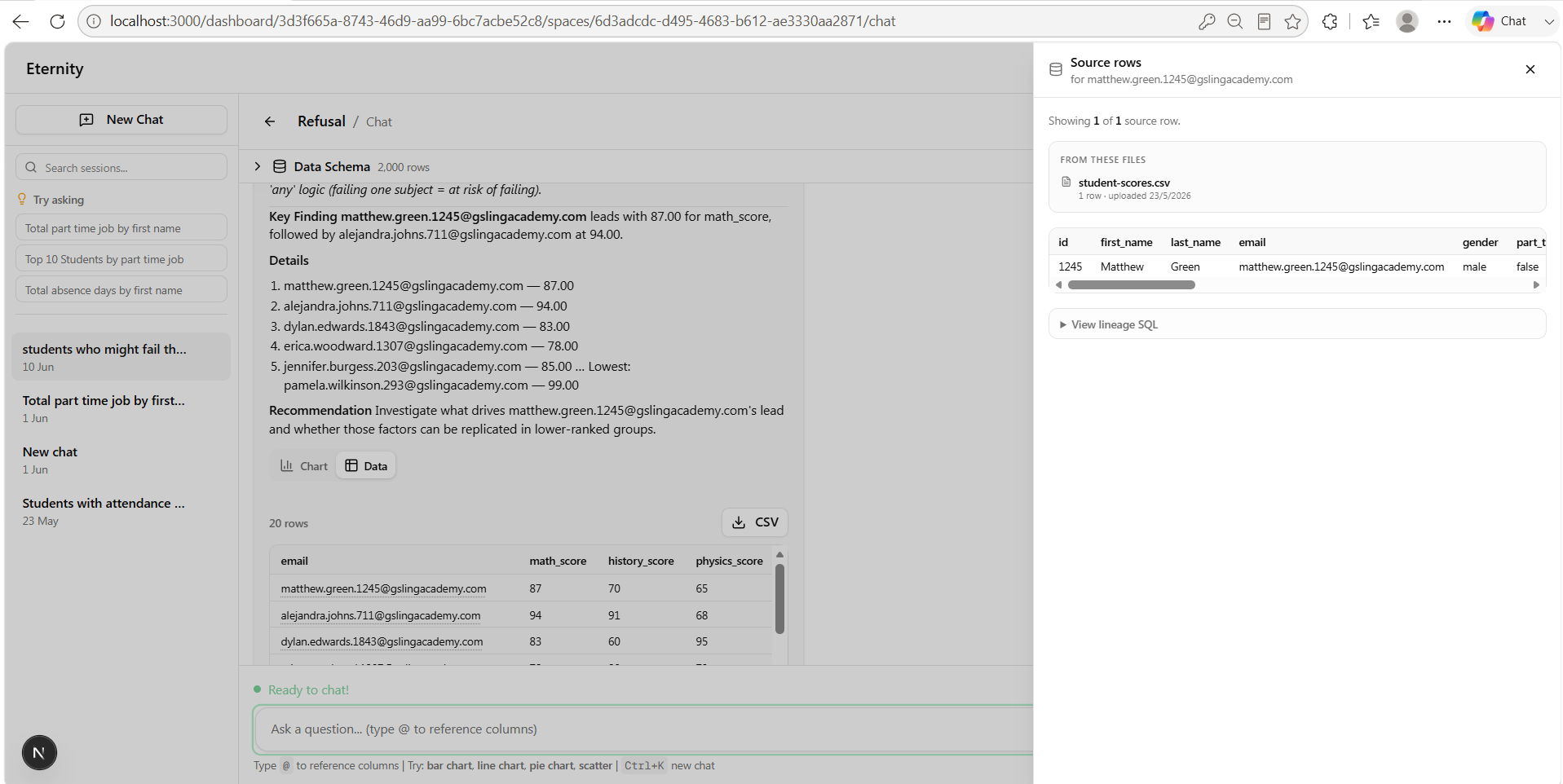
3. Confidence on every answer — and it refuses when unsure
Each answer carries a confidence score derived from real signals (how well the question matched the schema, whether filters resolved, how clean the data was) — not a hardcoded number. When a question is ambiguous, Eternity shows clarification options instead of guessing. When the data genuinely can't answer it, it refuses and tells you what's missing rather than fabricating a plausible figure.
A confident wrong number is the most dangerous output a data tool can produce. Eternity is built to not give you one.
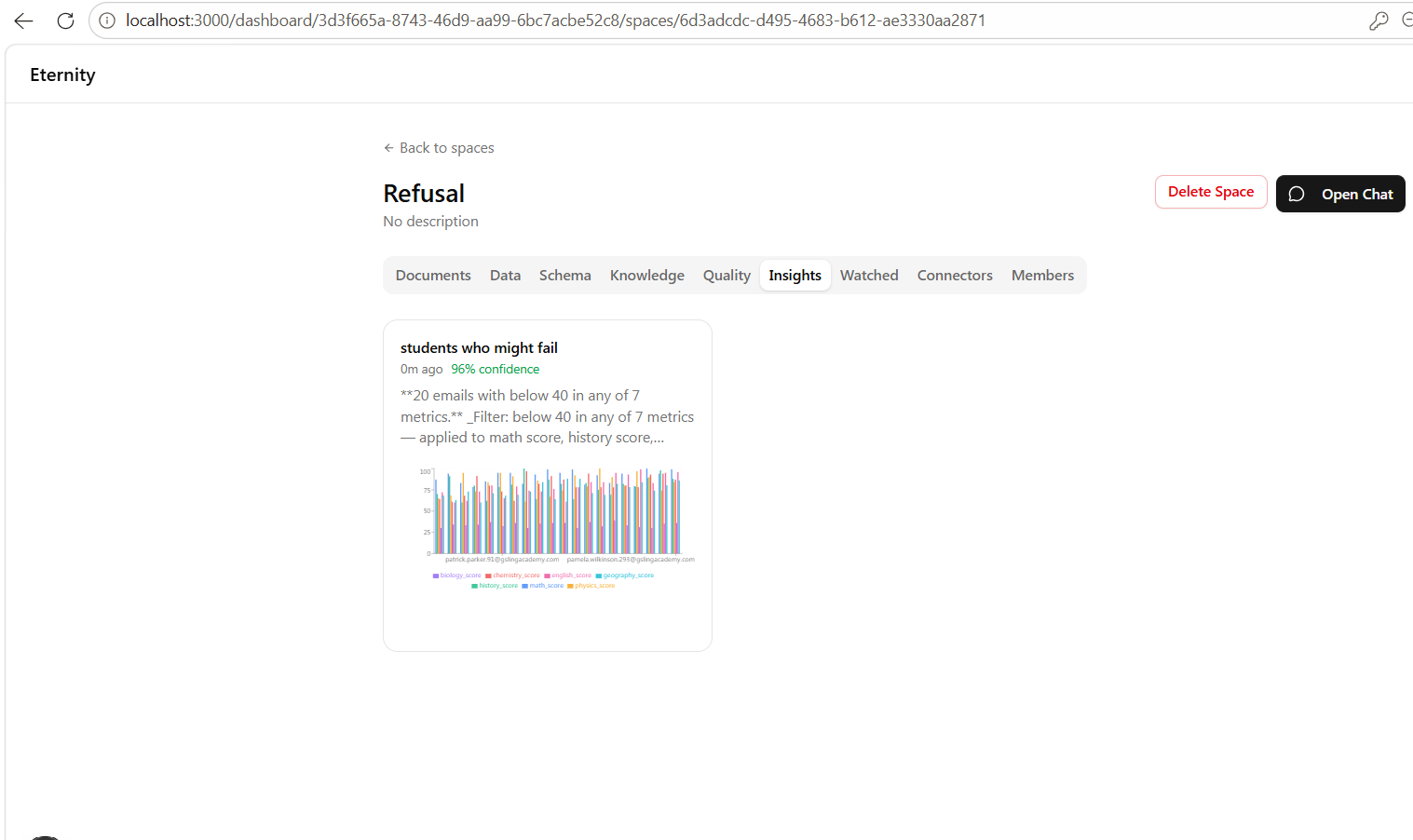
4. Reproducible snapshots — a number that can't silently change
Pin any result and Eternity freezes it: the answer, the SQL, the data hash, and a timestamp. A pinned result is a point-in-time affidavit — it is never re-computed behind your back. Share the link and everyone sees the same number with its full provenance. Ask the same question of ChatGPT twice and you can get two different answers; a pinned Eternity result is the same every time, by design.
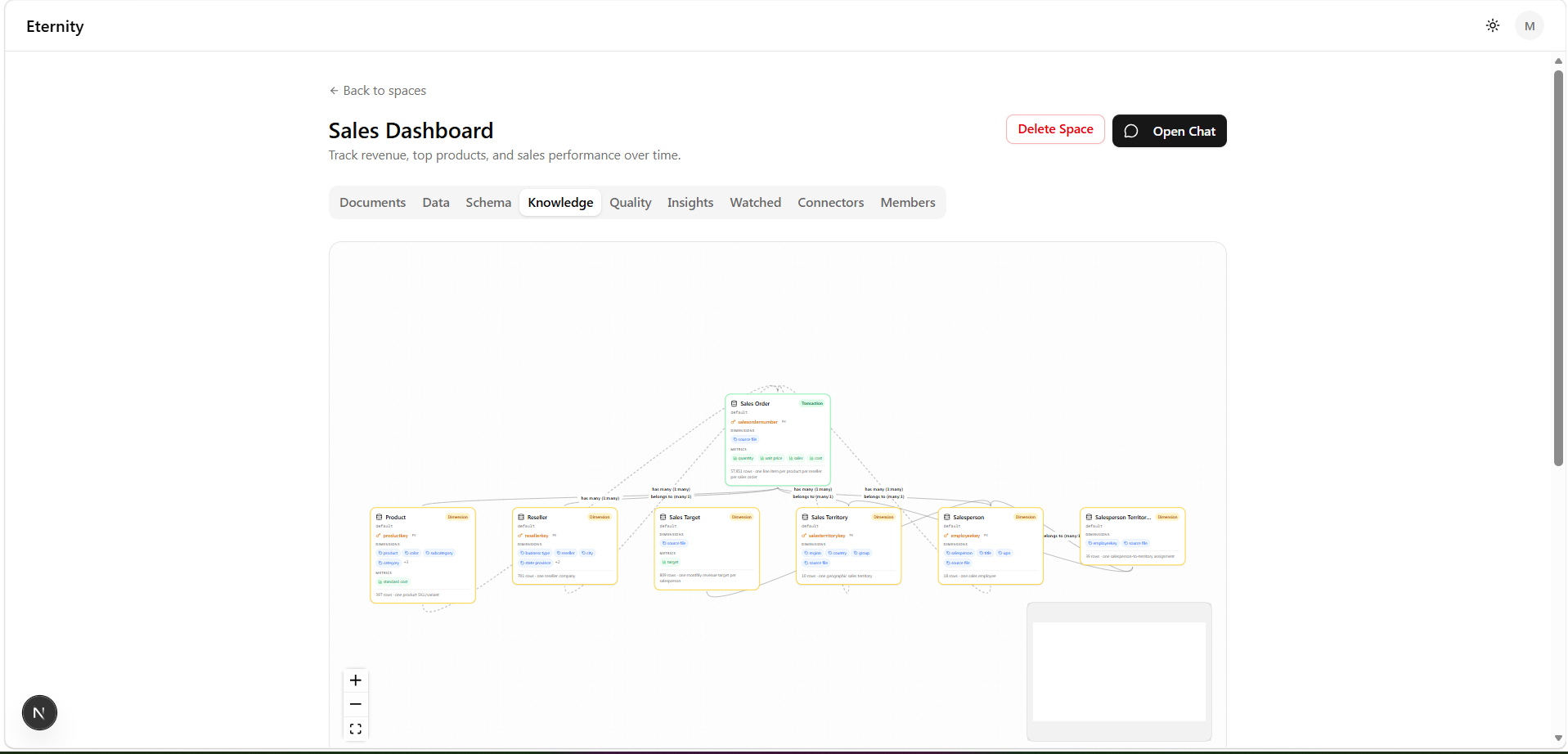
5. It figures out how your files join — automatically
Upload a ledger and a party master and a GST file, and Eternity builds a knowledge graph of how they relate — discovering the join keys for you. Ask a question that spans files (“revenue by state”, where state lives in a different file) and it assembles the joins itself, with the relationships visible so you can sanity-check them. No manual VLOOKUP, no telling it which column maps to which.
6. It handles the mess real data actually has
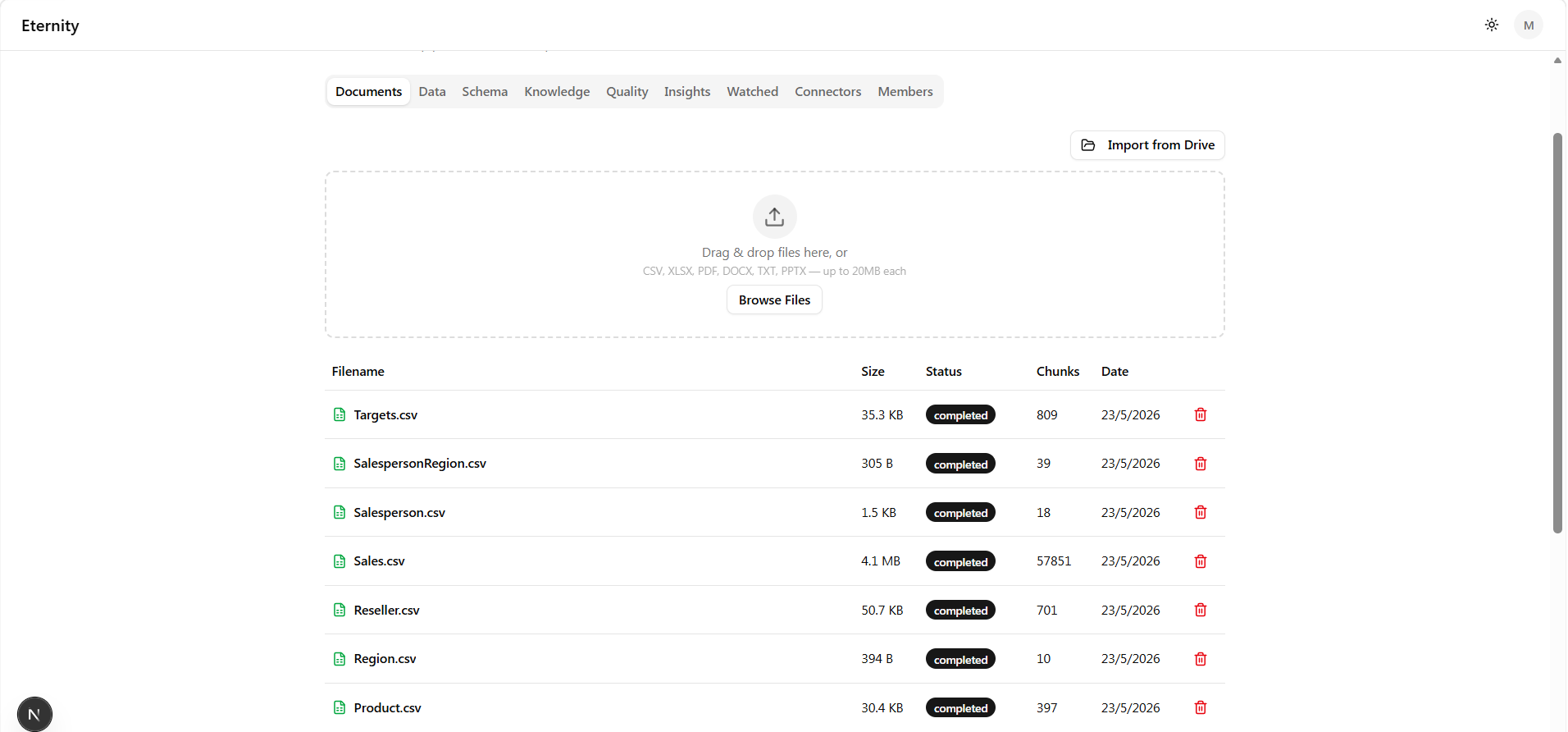
Indian lakh/crore formatting (₹1,23,456, 2 Cr, 75 L), Rs./INR prefixes, parenthesis-negatives, subtotal and GRAND TOTAL rows mixed into the data, mangled category casing, dirty join keys, mixed date formats — Eternity cleans and reasons over all of it. We put it head-to-head with GPT-5.5 and Claude on a deliberately brutal Indian ledger; it tied the best on accuracy at a fraction of the cost. (See our benchmark write-up.)
7. Data quality checks before you trust the data
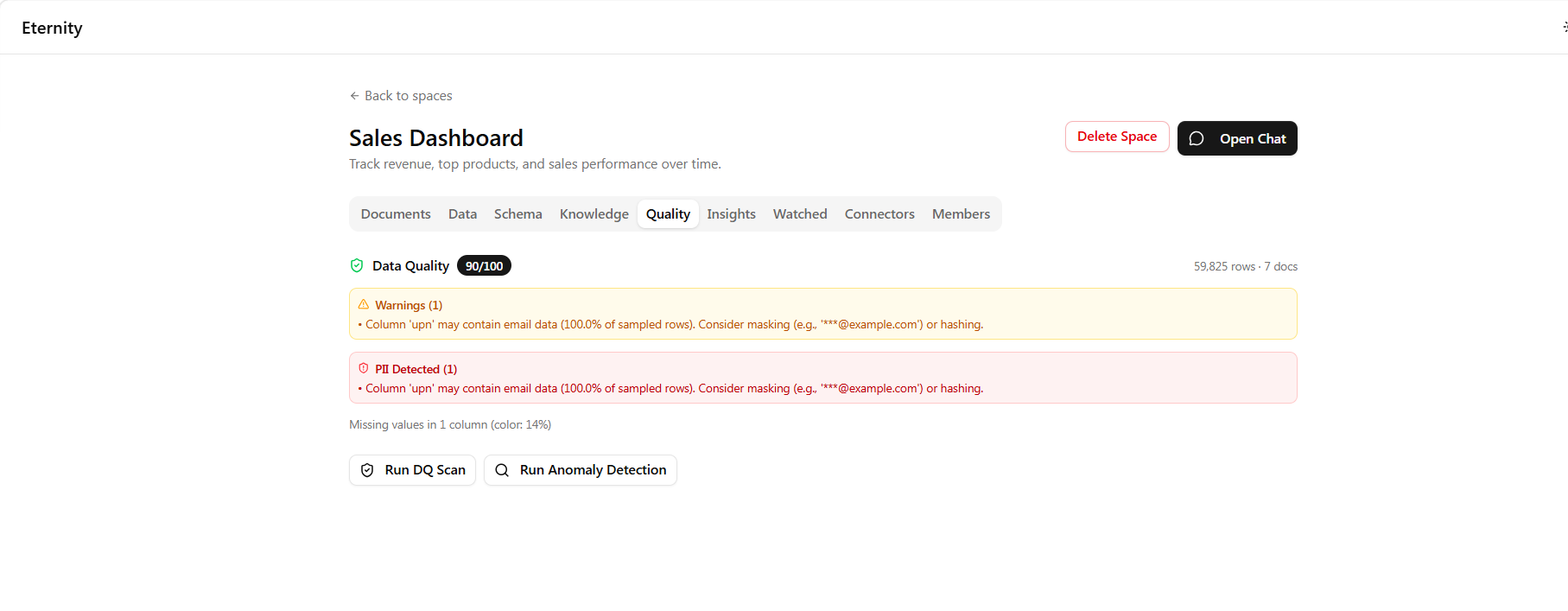
Before you build a decision on a file, Eternity flags what's wrong with it: PII in the columns, high-null fields, duplicate rows, out-of-range values, statistical anomalies, and schema drift when a new upload doesn't match the old one. The warnings surface in a data-quality panel so a bad export doesn't quietly become a bad number.
8. Proactive insights & metric watching
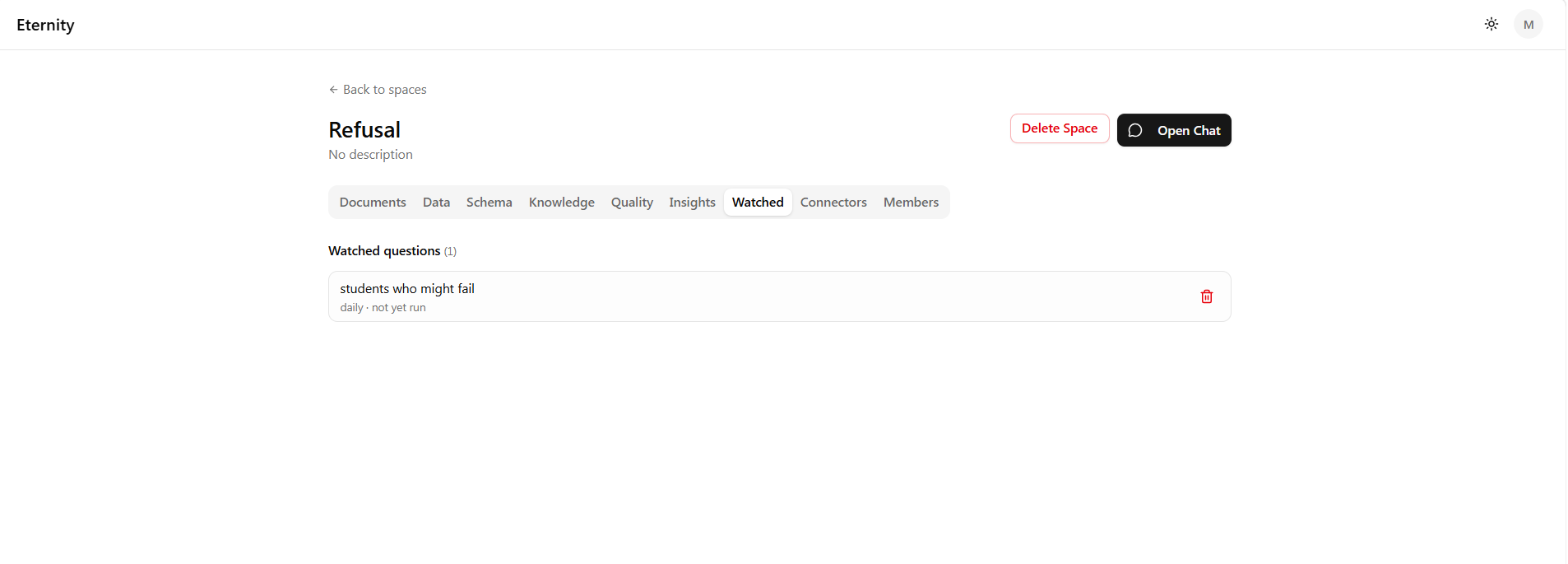
Eternity doesn't just answer what you ask — it surfaces what you didn't think to ask: automatic anomalies and trends in your data. And you can watch a metric so that when next month's file lands, you're told what moved — without re-running anything by hand.
9. Connect your data where it already lives
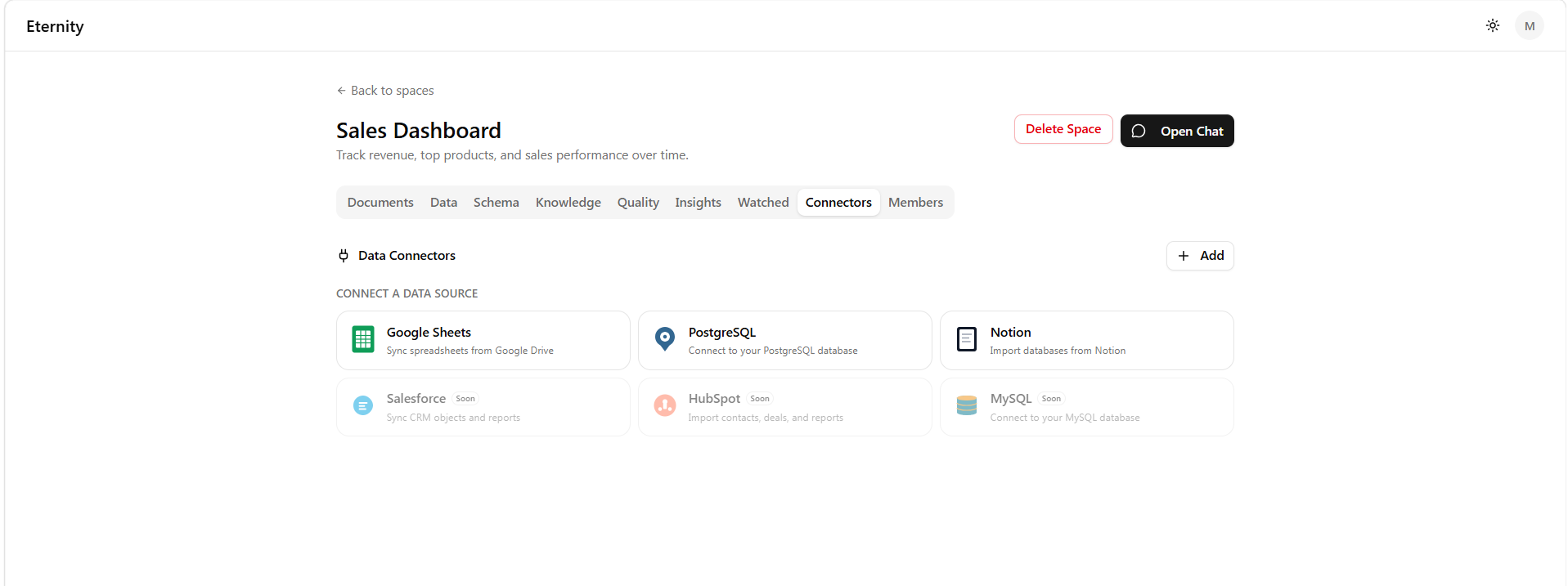
Beyond file uploads, Eternity connects to Google Sheets, PostgreSQL, and Notion, and can refresh on a schedule — so your answers reflect current data instead of a stale export.
10. Charts you can actually hand off
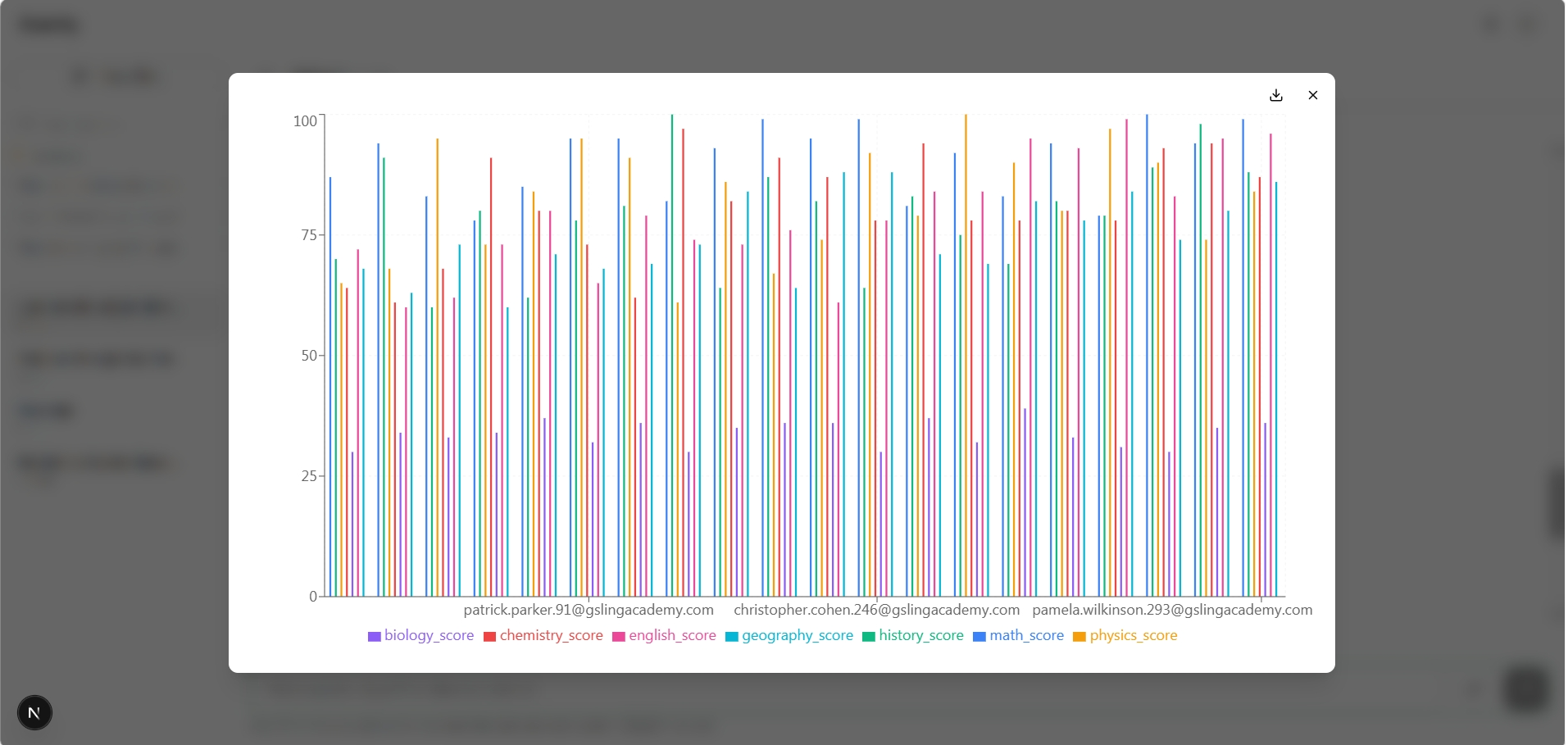
Bar, line, pie, and scatter charts generated from your answers — multi-series where it makes sense — and one-click PNG download so a chart goes straight into a deck or a client report.
11. It learns your business, so it stops guessing
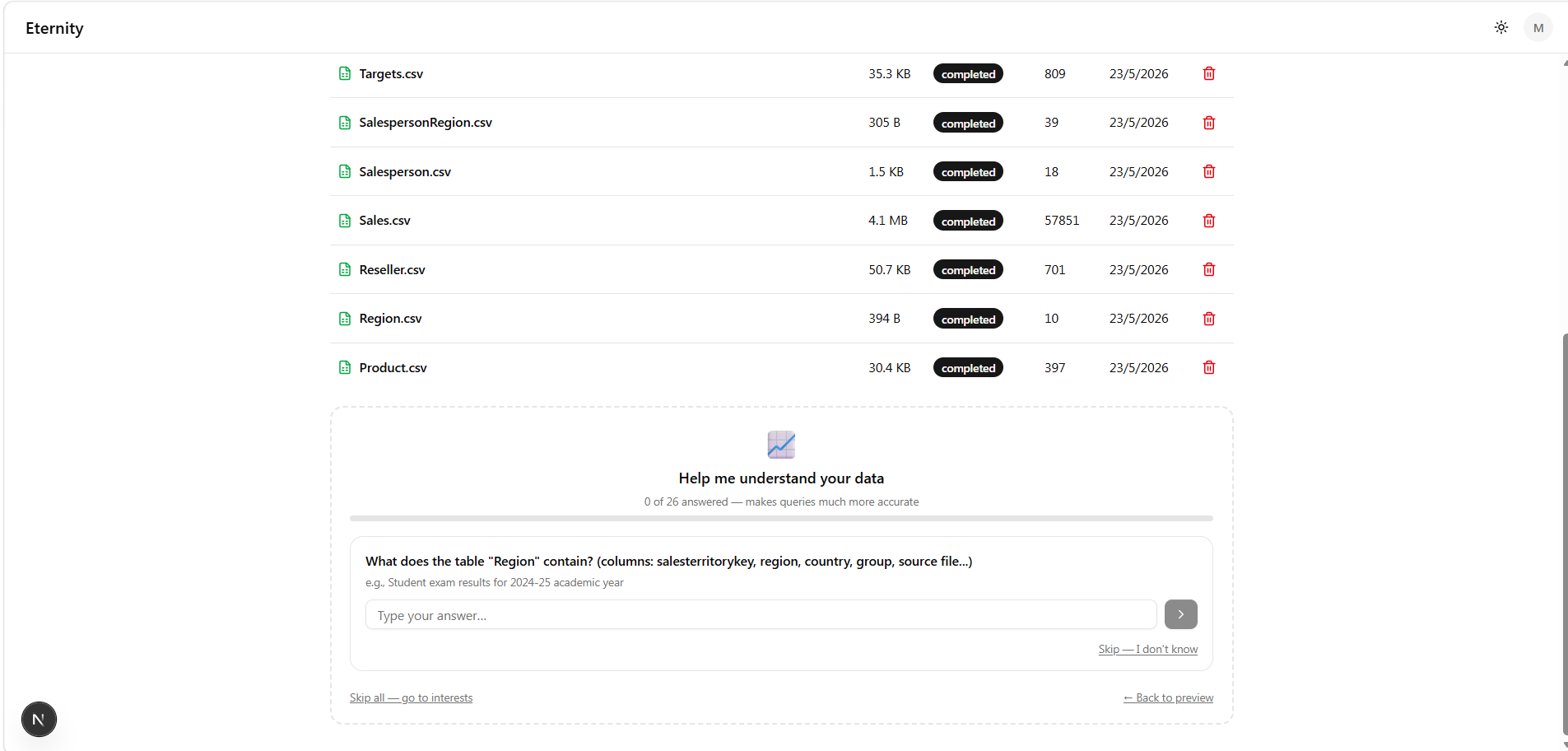
A short guided-ingestion wizard captures what your columns mean — which field is the metric that matters, what a coded value stands for, your thresholds and definitions. That business context flows into every future answer, so Eternity speaks your terminology instead of guessing every time.
The throughline
Speed and a clever model are table stakes now — GPT-5.5 has both. What you can't get from a chat box is an answer that's transparent (the SQL), traceable (the rows), calibrated (confidence + refusal), reproducible (pinned snapshots), and governed (data-quality + business context). That's the layer Eternity adds, and it's the layer that matters when a real decision — or a signature — rides on the number.
- Try the demo — no signup and see the SQL behind every answer.
- Upload a real, messy export and watch it resolve the joins and flag the data issues itself.